Wednesday, June 24, 2015

Digital Natives: Navigating Literate Worlds

Being Literate

"The ways in which young people use media culture today create new ways of conceptualizing what it means to become "literate" or competent in contemporary Western cultures."

This quote from Chapter 7, in my mind, means that there are many older people, and even teachers in our school systems, who are not wholly literate. So much of the world of youth is defined by, and partially dictated by, the media culture they participate in, and there are many digital immigrants who don't participate in, and aren't interested in that culture. Sadly enough, defiantly so.  And even more frustrating from my perspective is that some of them are the teachers I work with.  It only makes it more difficult to connect with our students when we aren't literate in their culture.

Google Generation

"The reasons students liked to use a search engine, and Google in particular, was because it was straightforward and easy to use, it seemed to have whatever a student wanted, and it meant that students did not have to access a range of databases."

In Chapter 8, so much of what was studied and discussed just seemed to make common sense to me.  Even though Google and Wikipedia aren't necessarily the most academic and specific ways of accessing information, they offer such an abundance of information they are the easiest first choice.  I know that Google is where I go many times each day, but I also realize that I know how to search much more skillfully than most of my students.  Students in higher education may not have direct access to academic studies and databases via Google, but they can usually find something that leads to those sources and gives them more focus once they then go to the databases.

E-Participation

"The results suggest that the young people perceiving a low degree of participation in information society do not have as broad an internet usage as those perceiving a high degree of participation."

I found this quote from Chapter 9 to be interesting and thought-provoking, that young people could be using the internet often, on a daily basis, and yet not feel a high degree of participation because of the limited number of, or limited types of activities they do online. The types of activities they did perceive as high participation had to do with political involvement, or community and government informational sites.  It's as if they feel that if they're not somehow involved with the greater society around them, via the internet, then they aren't fully participating.  It's interesting that they would feel that way, and must be a societal message they're receiving from somewhere?


The Role of Schools 

Because digital media is such an integral part of youth society, schools need to take on the responsibility of developing students' digital literacies.  Teaching digital wisdom should be taken very seriously, as it's increasingly apparent that the digital world is only expanding, and will continue to do so, and to influence all aspects of life.

According to Deconstructing Digital Natives, studies have found that students today enjoy "creating and sharing creations with others." The digital tools available in schools would allow this to happen on a large scale. Through guided participation in blogs, use of collaboration tools, use of online word processing applications, and even website creation, students can develop their academic writing, reading, and research practices with the added benefit of being able to publish and share their work.  Use of these digital tools also creates an added incentive because, according to Thomas Michael in Chapter 9, the students find "social connection" and "care about what other people think about what they have created."

Students also need to be taught online research methods, and schools are best suited to teach them these skills.  Every year, I find my students engaging in the "satisficing" searching that Michael talks about in Chapter 8.  Unless students are taught how to search intelligently and effectively, they will often use the first website or bit of information that pops up in an internet search.  They won't instinctively know to delve deeper, nor will they care to put in the extra time and effort necessary to find specific, reliable sources.  I quite often have to give my students a list of resources to use, so they are assured of accuracy and continuity when doing projects or writing assignments.

Also, we have to take seriously the way "new technologies change fundamental issues within established school subjects." (Chapter 7) This immediately brings to mind how the delivery of news has changed, not just for adults, but for teens as well.  Often, they will no longer turn to a textbook, newspaper, or television to find out information about past or present news or historical issues or topics, but will instead get their information from blogs, online news sites, and social media.  Again, it's important that they be taught how to find reliable and accurate information, and schools are the perfect place to learn these skills, because the teaching of them can be integrated into every subject area.

Thomas, Michael. Deconstructing Digital Natives: Young People, Technology, and the New            Literacies. New York: Routledge, 2011. 

The Satisficing Surgeon

Donnelly, Laura. Doctors Call for Law to Protect Them Against HIV. Digital image. The Telegraph. 2 June 2013. Web.
I think the section heading, "The Satisficing Surgeon" is a good explanation of what my meme is representing.  We all do satisficing searches, even when it's important to dig deeper and do more accurate research.  But, would we be okay with someone like a doctor, a pharmacist, our car mechanic, or any kind of skilled professional doing the same thing when doing something that affected us?


Wednesday, June 17, 2015

The Civic, Social and Multi Modal Lives of Digital Natives

Social Networking

"...boredom and frustration has set in with social networking sites and applications, and while such sites are still used by the 15-20 year-old group, they are not used as heavily or with as much excitement and commitment as hype about them would suggest."


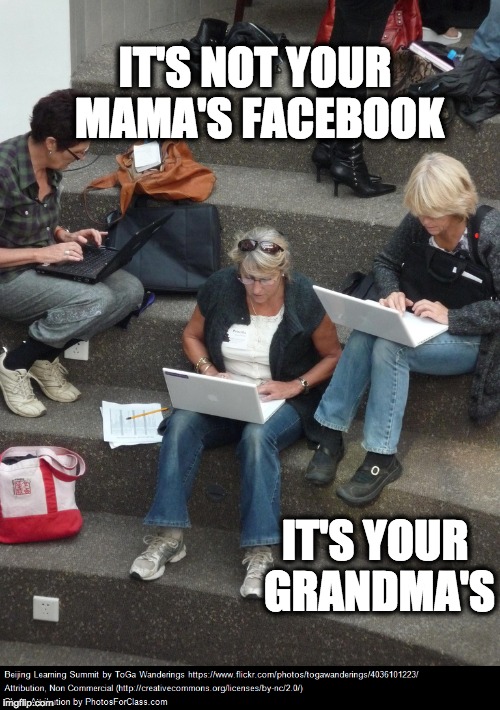
Much of what I'm reading about in Deconstructing Digital Natives brings my own children to mind, who are 18 and 19 years old.  The statement above, from Chapter 4, is also what I was thinking of, in some respects, when I created my meme.  My daughter was a big Facebook user when she was in middle school, and now rarely uses it.  The only thing she uses the site for now is to keep her relatives and older people in her life updated on what she's doing. Most of her aunts and uncles, and both of her grandmothers, are on Facebook, and use it regularly. It seems to me that she and my son are using a different app and/or SMS every time I turn around.


Neo-Digital Natives

"These social media give young people opportunities to communicate with a number of people who are outside school via mobile phones, and also to demonstrate their popularity among their friends...They are afraid of the isolation and estrangement that could result if they express their opinion too freely within a Japanese uchi that is constructed through people's online interaction on Mixi."

These are actually two separate quotes from Chapter 5, but I felt they went together, and what they said really impacted me, because they illustrate the peer pressure and social pressures that are associated with participation in certain SMSs.  I can imagine the same peer pressure that teens experience in school, in relationships, and in many other areas of life, also extended immediately to the use of social media sites when they became something used regularly.  Another aspect of that social pressure was, and is, the problem of cyberbullying.  It seems the internet and mobile media have opened up a whole new dimension to problems teens already experienced.

Creating Multi-modal Products

"There is a sense here perhaps of advancement on the one hand and of loss on the other."

This quote from Chapter 6 made me a bit sad, because I think it's true, to some extent, that as kids age they lose some of their tendency towards imaginative thinking and experimentation.  I'm not sure if that's a result of the way schools can sometimes try to standardize learning, thereby standardizing children, or if it's just the result of growing up and realizing what one should put his or her time and energy toward.  The description of the bright, colorful, confusing, mismatched gaudiness of the student's work when she was in Year 8 reminded me a lot of some of the Power Point projects my middle school students have done for me.  They do spend an inordinate amount of time experimenting with colors and fonts and animations, and much less time on the actual textual content and content development in these kinds of multi-modal projects.

Thomas, Michael. Deconstructing Digital Natives: Young People, Technology, and the New            Literacies. New York: Routledge, 2011.   


The point of my meme is that technology tools like Facebook, while new and interesting to the young 5 years ago (or more) have shifted in use.  Now its a tool often used by parents, and even to older people, grandparents.  As this shift happens, it's noticed by the young, and they no longer see the tool as desirable.  They move on to other things.

Sunday, June 14, 2015

"Digital Natives: Reflecting on the Myth"

The Digital Native, Digital Wisdom, and the Digitally Enhanced Human

Forward –
A quote from the forward that provoked some thought for me was, “Many so-called digital natives are no more intensive users of digital media than many so-called digital immigrants.”

I guess it didn’t take too much time and thought for me to realize that this is true.  Adults over 25 use digital media and technology all the time.  I think we just have the impression that young people are using digital media all the time, and more than older people do, because that’s something we see in public.  Many young people are on smartphones constantly, but older people are using these tools too, maybe just not in as public a way.

Chapter 1 –
A quote that I found interesting in Chapter 1 was “Advocates of technology integration in education attempt to understand the discourses that drive it and, in some cases, harm its acceptance, and find a balance between the technological innovations that can be sustained by sound pedagogy and those driven more by commercial interests.” 

When I read this, it made me think immediately of a ridiculous little technology tool (that shall remain nameless) that all of the English teachers in our school district were given a few years ago.  We went through training on how to use it, and had to make up lesson plans utilizing the tool in our classroom.  It was such a distracting tool, and had so many technical issues, that after one year (or less, in my case) it was no longer used by anybody in my building.  It was not something we requested, and we weren’t given any choices for possible tools to purchase, so we were very disappointed that so much had been invested in a flashy tool that didn’t work well and no one ended up using.

Chapter 2 –
A quote I agreed with from Chapter 2 was, “The distinction is, I think, much more about culture.  It is about younger people’s comfort with digital technology, their belief in its ease, its usefulness, and its being generally benign, and about their seeing technology as a fun ‘partner’ that they can master, without much effort, if they are shown or choose to.”

This is SO true in my classroom.  Kids don’t seem to be intimidated in the least by any technology tool I bring in to use, or ask them to use.  They immediately start trying it out, try to figure it out, click around on it or push buttons.  Most of the time I can’t hold them back enough to follow step-by-step instructions because they’re off and running with it.  And, they get so excited when they see the laptops or iPads in the room, or they know we’re going to the computer lab.  It seems like the exact opposite is true for so many of my fellow teachers.  They hesitate to learn something new, have a pessimistic attitude about training, and in some cases, brag about their technological ineptness.  I also realize that there is a degree of familiarity with technology on the part of young people, and have often gone to my son or daughter to help me with a tech tool.  They tend to find the missing link very quickly and easily, and sometimes will move so fast, I can’t follow what they’re doing!

Chapter 3 –
I’m not sure how I feel about the following quote from Chapter 3, “…in an unimaginably complex future, the digitally unenhanced person, however wise, will not be able to access the tools of wisdom that will be available to even the least wise digitally enhanced human.”  

I supposed it’s true that digitally unenhanced people won’t be able to access certain tools, but I think digitally enhanced, but unwise, people, will not use the tools they have access to.  Wisdom is not something that can appear from nowhere, and the unwise person won’t seek it out unwontedly, whereas the wise person learns from and seeks wisdom, and will realize the wisdom in using the tech tools available to him/her.  It seems like a presumptuous statement to make.

Reflections

I had never though too much about the meaning of the term “digital native,” even though it is a term I’ve used frequently myself.  My thinking has been along the lines of what the author was saying in this book, that we assume that kids know how to use technology instinctively because they’ve been around it all their lives.  I don’t know why I felt that way.  My classroom experiences have shown persistent evidence to the contrary.  I’ve loved computers, technology, and the Internet since they first became regular household items in the 90’s.  Because of this interest, I know more about many tech tools than my peers and my students, and I’m definitely not a digital native. 

The idea of “digital wisdom” is something I will be using regularly in the future.  Without realizing it, this is exactly what I have felt we needed to focus more attention on in schools.  In the same way we teach our students social skills, how to behave, and how to be responsible, they also need guidance and help learning how to use technology wisely, and we need to take that responsibility seriously.  Part of taking it seriously, is making sure we understand the tools ourselves.

I need to get used to the idea of the digitally enhanced person.  The term brings up images of robots, the Terminator, and the Million Dollar Man, although I realize that’s not what the author was referring to. After reading more about the term, I do understand the concept, though, and agree that the future will become so complicated and full of information that a person would be unwise to remain digitally unenhanced.  Technology already has created a global society that is aware of, or has the ability to know, what’s happening in most parts of the world.  Although knowledge is power, it also complicates and makes life much more complex. We all need to learn how to use technology to our advantage in dealing with this complexity, but also make sure we don’t get overwhelmed by it.  That will be, and already it, the challenge.

Thomas, Michael. Deconstructing Digital Natives: Young People, Technology, and the New            Literacies. New York: Routledge, 2011.   

Technobaby


The visual metaphor in "Technobaby" is the idea that children born during the time of technology tools inherently understand and can use them.  Although many digital immigrants may think that the baby holding the iPad in the above picture knows exactly what he/she is doing with it, and how to use it, the reality is that the child has to be taught and shown how to use it...possibly even by a digital immigrant.


Saturday, June 6, 2015

"Digital Media Effects on Conventional Reading and Writing Practices"


Modern Technology's Affect on Writing

I agreed with the following quote from the article by Karp, “…while the type of error has changed, the ratio of errors to words has held steady for more than 100 years.” This quote also supports several of the historical statements shown by Josh McWhorter in the TED talk he gave.  Written language being fairly new in the timeline of history, it makes sense that it has changed and evolved with the technology and tools used by society, but that doesn’t mean that writing skills have gotten worse with these changes.

 “The kinds of skills Zachary has developed — locating information quickly and accurately, corroborating findings on multiple sites — may seem obvious to heavy Web users. But the skills can be cognitively demanding.” This is a quote from the New York Times article that I also agreed with.  I know this to be true from personal experience.  Looking for, finding, analyzing, and using information from web articles and web sites takes as much skill and time as finding it in written form.  This is mostly due to the fact that there is so much information available, and it can be found quickly and easily.  Instead of two or three written sources, one can find ten or fifteen on the Web.  The key is to evaluate the reliability and validity of the information found, and there are even tools available to do that.

This topic is particularly interesting to me because I’m an English teacher.  When I started teaching, in the late 1980s, there was no such thing as a cell phone, and students had never heard of texting. Now I’m teaching the same age of student the same subject, but texting is an integral part of most of their lives.  I haven’t noticed a significant decline in writing skills, but I have noticed that I have to emphasize “formal” writing skills with my students, and explain the purpose for it in life.  Just as was stated in the TED talk, it’s become apparent to me that students have learned a new language. “ …the writing we produce is not getting worse.  Instead, it is simply adapting to the modern world.” (Karp, 2010) Students need to understand that their texting language is different, and a language to be used in certain contexts. “Bad and good writing is in the eye of the beholder…It’s all in the relationship of the recipient to you.” (Karp, 2010)

I don’t believe that reading skills have declined because of the Internet and texting. “Books aren’t out of the picture, but they’re only one way of experiencing information in the world today.” (Motoko, 2008) Students are simply finding a way to navigate the world they live in, and our society is increasingly global.  Because of the Internet, there is more information out there, right at our fingertips. This was never the case before.  Students are curious information seekers.  They don’t need to be taught to look in only one place for their information, they need to be encouraged to continue learning, growing, and seeking information.  Their ways of doing this have changed and adapted with the tools available to them.  That doesn’t make them less skilled; it expands their abilities and makes them more capable. “…the Internet has created a new kind of reading, one that schools and society should not discount.” (Motoko, 2008) 

Karp, Josh. "Does Digital Media Make Us Bad Writers?" Spotlight on Digital Media and Learning. 26 Jan. 2010. Web. 2 June 2015.

Rich, Motoko. "Literacy Debate: Online, R U Really Reading?" The New York Times. The New York Times, 26 July 2008. Web. 4 June 2015.


Friday, June 5, 2015

My Blabberize About Texting

 The important things I learned from the video are texting is not just bad writing, there is value in the language of texting, and young people have expanded their skills because of texting.  But the most important thing I learned is texting is an intellectual and linguistic advancement.

Using Blabberize

I think there would be multiple uses for Blabberize in a middle school English class.  I could have students write a summary of an article, poem, or short story theme and create a Blabberize to show to the class.  I could also have the students write their own short poems or six-word memoirs and create a Blabberize for them.  They could use them with vocabulary words by choosing an image that is somehow related to the word, then have the image define the word and use it in a sentence.  This could be a way for students to review vocabulary by watching each other's Blabberizes.  I could probably think of many ways for them to use the website.